Malaysian buyers check a website before they call, visit or pay. That habit now shapes almost every industry, from property agencies in Kuala Lumpur to cafés in Penang and manufacturers in Johor. Therefore, a weak site quietly costs sales every single day.
After two decades of building and auditing business sites, I have noticed one pattern. Most underperforming websites do not fail because of bad taste. They fail because someone skipped the basics. This web design Malaysia checklist walks through those basics in plain language, so you can judge your own site honestly.
Why a checklist beats guesswork
Design opinions vary wildly. One director wants a video header. Another wants more white space. Meanwhile, nobody checks whether the site loads in under three seconds.
A checklist removes that noise. Every solid web design Malaysia project turns a vague conversation into clear, testable items. As a result, your team argues less and ships faster. More importantly, you fix the issues that actually move enquiries, not just the ones people notice in a meeting.
1. Start with a clear purpose
Every good website answers one question first: what should a visitor do here?
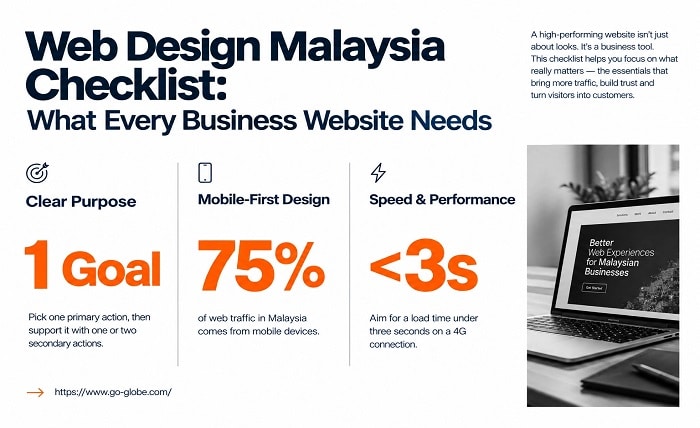
Some businesses want phone calls. Others want quote requests, bookings or online orders. Pick one primary action, then support it with one or two secondary actions. Consequently, your layout, copy and buttons all pull in the same direction.
Write this purpose down before any design work begins. Strong web design Malaysia projects almost always start with that single sentence.
2. Make it mobile-first, not mobile-friendly
Malaysia has one of the highest smartphone usage rates in Southeast Asia. Most local sites now see the majority of their traffic from phones. Therefore, you should design for a small screen first and expand upward.
Check these items on an actual device, not just a browser preview:
- Text stays readable without pinching or zooming
- Buttons sit far enough apart for a thumb
- Menus open smoothly and close just as easily
- Forms fit the screen and trigger the right keyboard
- Images resize instead of overflowing
A responsive website design should feel natural on a mid-range Android phone, not only on the newest iPhone in the office.
3. Fix your loading speed
Speed remains the most ignored item on any web design Malaysia checklist. Yet it affects rankings, bounce rates and conversions at the same time.
Aim for a load time under three seconds on a 4G connection. To get there, compress your images, remove unused plugins and choose hosting with a server close to your audience. In addition, lazy-load images that sit below the fold.
Test your homepage and two inner pages. Pages often behave very differently, so one test tells you very little.
4. Keep navigation simple
Visitors should find any key page within two clicks. However, many Malaysian business sites still hide services behind clever labels or long dropdown menus.
Use plain words. “Services” beats “What We Do”. “Contact” beats “Say Hello”. Furthermore, limit your main menu to five or six items. Everything else belongs in the footer.
A sticky header helps on long pages, because the menu stays within reach while people scroll.
5. Earn attention in the first screen
The top of your homepage carries enormous weight. Within a few seconds, a visitor decides whether to stay.
Three elements do the heavy lifting:
- A headline that states what you do and who you serve
- A short supporting line that adds detail or proof
- One obvious button
Avoid vague slogans. “Trusted partner for growth” tells nobody anything. “Air-conditioning servicing for offices in Klang Valley” tells them everything.
6. Show trust signals clearly
Malaysian buyers stay cautious online, and rightly so. Consequently, your site must prove that a real company stands behind it.
Include your full business name, registration number, physical address and a local phone number. Moreover, add real photos of your team, office or completed work. Stock images of foreign boardrooms weaken credibility instantly.
Client logos, testimonials, certifications and association memberships all help. Place at least one trust element on every important page, not only on the About page.
7. Handle language the local way
Malaysia runs on multiple languages, and your audience decides which ones matter. Many B2B sites work well in English alone. Retail, healthcare and government-linked sites often need Bahasa Malaysia, and sometimes Chinese too.
If you publish multiple versions, keep them complete. Half-translated pages frustrate readers and confuse search engines. In addition, use a clear language switcher in the header rather than a tiny flag icon in the footer.
Good web design Malaysia work respects how people actually read, search and speak here.
8. Build SEO into the structure
Search visibility depends on structure as much as content. Therefore, sort these items during the build, not months later.
- One H1 per page, describing the topic clearly
- Descriptive page titles under 60 characters
- Meta descriptions that read like sentences, not keyword lists
- Clean URLs without random numbers
- Alt text on every meaningful image
- An XML sitemap submitted to search tools
- Internal links between related pages
Create a separate page for each core service. A single page listing eight services will rarely rank for any of them. This principle sits at the heart of SEO-friendly web design.
9. Make contact effortless
Every extra step costs you enquiries. So reduce friction wherever you can.
Show your phone number in the header, and make it tappable on mobile. Add a WhatsApp button, since many Malaysian customers prefer chat over email. Keep contact forms short, because each additional field lowers completion rates.
Also, tell people what happens next. A simple line such as “We reply within one working day” sets expectations and reduces drop-off.
10. Prepare properly for e-commerce
If you sell online, the checklist grows. An e-commerce website needs local payment options, including FPX, credit cards and popular e-wallets.
Beyond payments, cover the practical details:
- Clear shipping rates and delivery timelines
- A visible return and refund policy
- Product photos from several angles
- Stock availability shown honestly
- Guest checkout for first-time buyers
Test the full purchase journey yourself, on a phone, using a real card. You will find issues that no internal demo reveals.
11. Design for accessibility
Accessible sites serve more people and usually rank better too. Fortunately, the basics take little effort.
Use strong colour contrast between text and background. Avoid text baked into images. Keep font sizes at 16 pixels or above for body copy. Furthermore, make sure the site works with keyboard navigation alone.
Older customers benefit enormously from these choices, and so does everyone reading outdoors in bright Malaysian sunlight.
12. Install analytics from day one
You cannot improve what you never measure. Install analytics before launch, then set up conversion tracking for calls, form submissions and chat clicks.
Review the data monthly. Look for pages with high exits, forms with low completion and search terms that bring visitors in. Over time, these numbers guide your next round of improvements far better than opinion does.
13. Protect the site and keep it updated
Security belongs on every web design Malaysia checklist, because neglected sites get hacked. Any experienced web design company in Malaysia will treat an SSL certificate as the bare minimum, since browsers now warn visitors about unsecured pages.
Beyond that, schedule regular updates for your platform, themes and plugins. Set up automatic backups stored off-site. In addition, use strong passwords and two-factor authentication for admin accounts.
Plan for maintenance from the start. A website is an asset that needs upkeep, much like a company vehicle.
14. Respect PDPA and privacy expectations
Malaysia’s Personal Data Protection Act applies to businesses that collect customer information. Therefore, your site needs a privacy policy that explains what you collect and why.
Add a cookie notice if you use tracking tools. Keep your consent checkbox honest rather than pre-ticked. These small touches signal professionalism, and they protect you if questions arise later.
15. Write a brief before you hire anyone
Most disappointing projects start with a vague brief. So put the important details on paper first.
Your brief should cover your business goals, target customers, must-have pages, preferred tone and rough budget. In addition, list two or three sites you admire, and explain what you like about each one. Specific feedback saves weeks of revisions later.
Agree on ownership too. You should hold the domain, hosting account and content management login in your own name. Otherwise, moving to a new partner becomes painful. Experienced web design Malaysia teams will encourage this arrangement, because clear ownership protects everybody.
Finally, set a realistic timeline. A small brochure site takes four to six weeks when content arrives on time. Content delays, not design work, cause most missed deadlines. Prepare your text, photos and product details early, and the whole project moves faster.
Common mistakes worth avoiding
Certain problems appear again and again during audits:
- Auto-playing video with sound
- Contact pages without a phone number
- Blog sections abandoned two years ago
- Pop-ups that appear within three seconds
- PDF brochures used instead of real web pages
- Broken links after a redesign
Each one is easy to fix. Together, however, they can undo months of marketing spend.
Your quick reference checklist
Run through this list before any launch:
- One clear purpose per page
- Mobile-first layout tested on real phones
- Load time under three seconds
- Simple menu with plain labels
- Strong headline above the fold
- Visible trust signals and company details
- Language versions that suit your audience
- SEO structure in place at launch
- Easy contact options, including chat
- Working payment and checkout flow
- Accessible colours, fonts and navigation
- Analytics and conversion tracking active
- SSL, backups and update schedule ready
- Privacy policy and cookie notice published
Final thoughts
A business website rarely fails for dramatic reasons. It fails through small gaps that nobody owns. This checklist gives you a shared standard, so your team can spot those gaps early and close them properly.
Review your site against this web design Malaysia checklist every six months. Markets shift, devices change and customer expectations keep rising. Consequently, a site that performed well in 2023 may already feel dated. Steady attention beats an expensive rebuild every few years.
Website standards here have moved quickly over the past decade, and studies published by GO-Globe have tracked much of that shift, from simple brochure pages to sites that carry real commercial weight. Interestingly, the fundamentals have barely changed in that time. Clarity, speed, trust and easy contact still separate the sites that bring in enquiries from the ones that simply exist online. Treat this checklist as a working document, revisit it with every update, and your website will keep earning its place in your marketing budget.