
Most product videos skip the story entirely. A product appears, its features get listed, a price point gets mentioned, and the video ends. It’s functional marketing, but it’s not memorable. What actually moves people to care about a product is the story around it — not the product itself, but what it enables, who it’s for, and what changes when someone chooses it over the alternative.
The advanced text to video technology has made the mechanics of producing this kind of narrative video faster, but Dreamina’s Seedance 2.5 model was built with something more specific in mind: turning a compelling product story, written out fully in words, directly into finished footage that carries that narrative weight.
The difference between showing and telling a story
A product video that simply displays features is one thing. A product video that tells a story about why those features matter is something else entirely. The first makes a viewer understand what a product does. The second makes them feel why they might need it. That emotional connection is what actually drives purchasing decisions, yet it’s also the part that’s hardest to execute without either overcomplicating the production or leaning too heavily on sentimentality that feels false.
This is where text-to-video becomes genuinely useful. A writer can articulate a product story far more clearly in words than a filmmaker can usually capture in a single shoot, especially under the time and budget constraints most product video production works within. The challenge has always been translating that written narrative into something visual that actually carries its weight.
Why products need narratives, not just demonstrations
A product that solves a real problem for a real person is infinitely more compelling than the same product described by its specifications. A coffee maker isn’t interesting because it has a timer — it’s interesting if a story shows someone rushing out the door and realizing, because of that timer, they don’t have to rush quite as hard. A notebook isn’t valuable because it has good paper — it’s valuable if a story shows an idea finally making it from a person’s head onto something permanent.
This reframing is what transforms a product video from something viewers skip past into something they might actually watch, share, and remember. The product becomes a supporting character in a larger narrative rather than the sole subject of an advertisement.
What makes Seedance 2.5 capable of carrying narrative weight
Seedance 2.5 was built to understand and execute narrative structure, not just visual flourishes. A story beats differently than a commercial, and the model was trained with that distinction in mind.
Pacing that respects story structure
A narrative needs room to breathe, to let moments land. Seedance 2.5 supports single-clip generation up to 30 seconds, and an Ultra-long Video Generation mode extending to 180 seconds, which means a complete story arc can unfold in one continuous take rather than being chopped into disconnected clips. That continuity is what carries emotional weight.
Character consistency that supports emotional investment
If a viewer is meant to connect with a person in a story, that person needs to feel like the same person from beginning to end. Cumulative errors that used to cause drift across a sequence are largely resolved, so a character’s appearance, expression, and energy stay consistent as a story develops, supporting the viewer’s emotional investment in that character and their journey.
Realistic human behavior, not performance
The “AI look” that made earlier generated video feel sterile and artificial has been noticeably reduced. Motion transfer consistency has climbed to over 90%, which matters enormously for storytelling, since a story’s power depends on believing the people in it are genuine, not performing for a camera. Small, unscripted-feeling gestures, natural pauses, authentic reactions — these are what make a story land as real rather than staged.
Multimodal input that honors the written story
The model accepts up to 50 pieces of multimodal material at once, including text, images, and audio. This means a complete product narrative, written out fully, can inform the generation directly, ensuring the video stays faithful to the story’s emotional arc rather than reducing it to isolated moments.
From story to screen with clarity
Step 1: Write the story first, then describe what you see
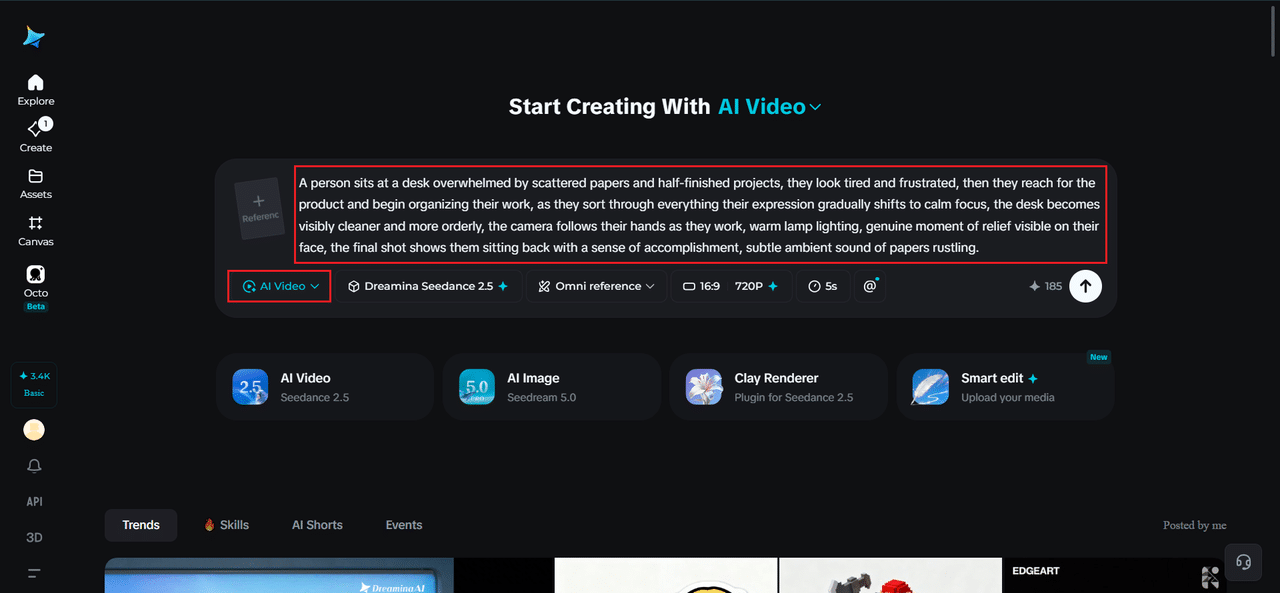
Visit Dreamina, sign in, and head to the “AI Video” section. Before writing your prompt, write out the full story in a paragraph or two — who the person is, what they’re dealing with, how the product changes things. Then, click “Add reference image” if you have a photo of the product or the person who’ll be in the video. Write a detailed prompt that turns the story into visual direction.
A detailed prompt for a 30-second sequence might read: A person sits at a desk overwhelmed by scattered papers and half-finished projects, they look tired and frustrated, then they reach for the product and begin organizing their work, as they sort through everything their expression gradually shifts to calm focus, the desk becomes visibly cleaner and more orderly, the camera follows their hands as they work, warm lamp lighting, genuine moment of relief visible on their face, the final shot shows them sitting back with a sense of accomplishment, subtle ambient sound of papers rustling.
Step 2: Select Seedance 2.5 and generate your narrative
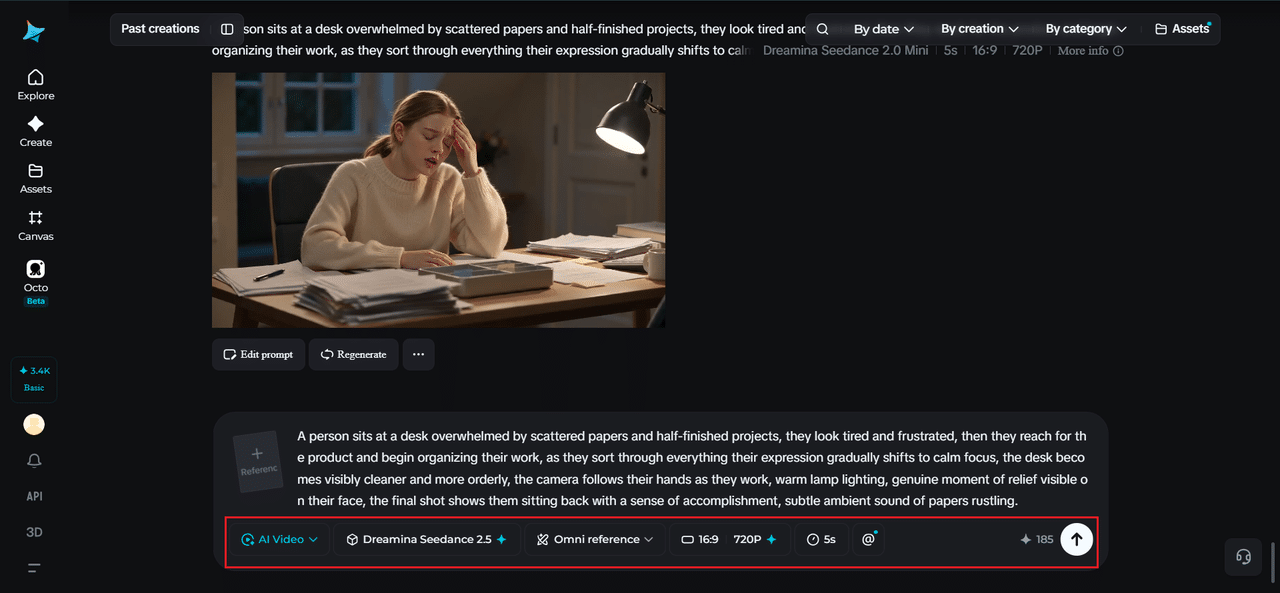
With your prompt capturing the story’s emotional arc, select the Seedance 2.5 model for generation. Choose your video length — 30 seconds or longer depending on how much story needs to unfold. Pick an aspect ratio suited to where it will run — 16:9 for YouTube or brand websites, 9:16 for social platforms. Click Dreamina’s generation icon and let it build your story from the narrative you’ve written.
Step 3: Refine and release the story
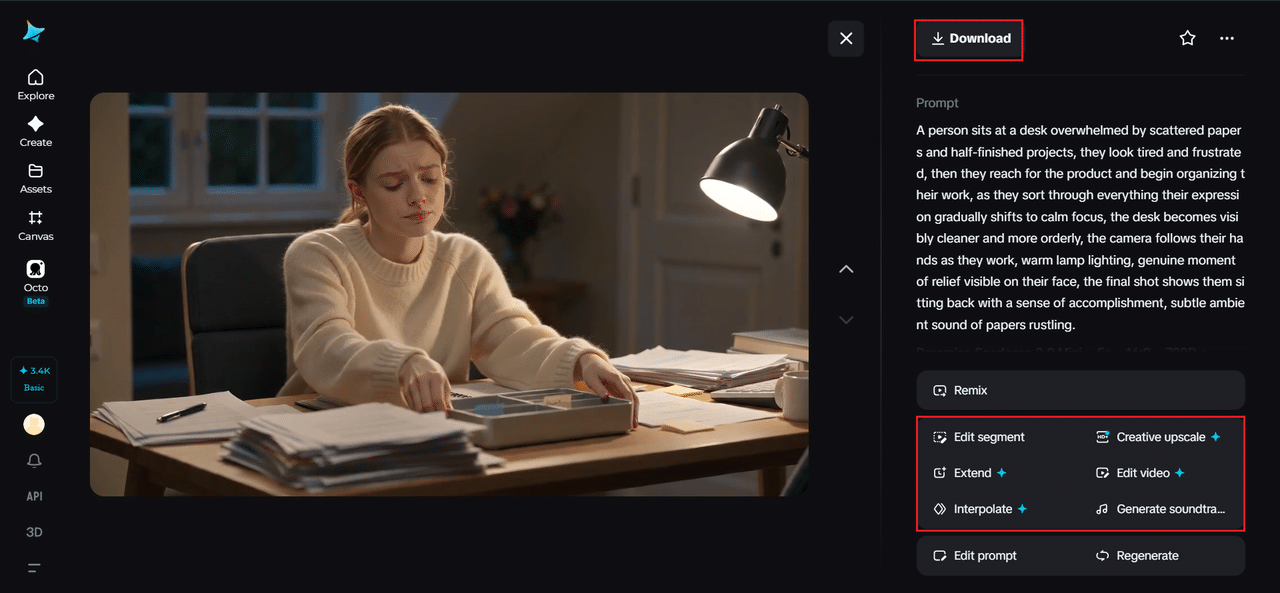
Use Dreamina’s AI editing tools to adjust any details that need sharpening. Upscale improves resolution, while Generate Soundtrack adds audio that supports the emotional arc — subtle, building music or ambient sound that mirrors the story’s progression. Once it feels complete, export and share it across platforms, letting the story carry your product rather than the product carrying the story.
Building a story that a product can carry
The first step isn’t actually generating anything. It’s articulating the story clearly.
-
Who is this product for?
-
What problem are they facing?
-
What changes when they have it?
These questions should be answerable in a single paragraph before a single frame of video is generated. A product story without a clear emotional core is just a demonstration with better cinematography.
The narrative arc that makes a product matter
Every effective product story follows a recognizable shape: a person with a need or problem, a moment of discovery or realization, and a shift in how that person moves through their day. The product is the catalyst for that shift, but it’s not the story itself.
The story is always about the person and how their life changes. A product video that keeps that focus is infinitely more powerful than one that centers on the product itself.

Translating emotion into a text prompt
The unique strength of text to video is that a writer can describe emotion and narrative intention directly, without needing to hope a cinematographer or director interprets it the same way.
A prompt can say “the viewer should feel a sense of relief washing over this person” and the generation will pull toward that emotional tone. This specificity is what allows a written story to translate into generated video without losing its narrative spine.
When a story becomes more memorable than the product
The most effective product videos are often the ones where viewers remember the story long after they’ve forgotten the product name. That’s not a bug — it’s exactly the point. A story that resonates enough to be remembered is a story that’s also going to create positive association with whatever product appears in it. The product becomes woven into a narrative a viewer actually cares about, which is infinitely more powerful than any list of features.
With Dreamina and its Seedance 2.5 model, a compelling product narrative written in words can move directly into generated video, carrying that same emotional weight from concept to screen without the narrative getting flattened along the way.